
[Call No. 8/2025/SINTER] Andifes Languages without Borders (ISF) Network – Selection of Tutors: Results
This post is available in Brazilian Portuguese only. Please access the website in Portuguese to read it.
This post is available in Brazilian Portuguese only. Please access the website in Portuguese to read it.
This post is available in Brazilian Portuguese only. Please access the website in Portuguese to read it.
This post is available in Brazilian Portuguese only. Please access the website in Portuguese to read it.
This post is available in Brazilian Portuguese only. Please access the website in Portuguese to read it.
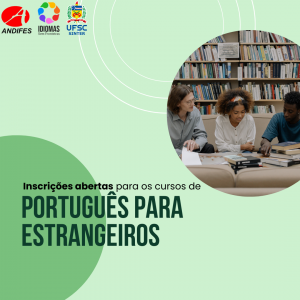 The Andifes IsF (Languages Without Borders) Network is accepting applications until 23 May 2025 at noon (Brasília time) for its Selection Process to fill seats in online Portuguese language courses for foreigners. Applications are open to all foreign nationals, whether or not they currently reside in Brazil or are enrolled in an educational institution.
To apply, complete the application form for the desired course (links provided below). At this time, three beginner-level classes are available:
Aspects of Brazilian culture – Class 1 (level A1)
Institution: Universidade Federal da Paraíba (UFPB)
Workload: 32 hours
Days of the Week: Mondays and Wednesdays
Time: 2 pm
Application Link: Click here

Source: World Humanities Report
The article The Languages Without Borders Network in Brazil has been published in the World Humanities Report and is now available on the Andifes-IsF Network website. Written by Denise Abreu-e-Lima (Federal University of São Carlos) and Waldenor B. Moraes Filho (Federal University of Uberlândia), with contributions from the Andifes-IsF Network, the article offers an in-depth analysis of the program’s evolution, its connections to the former Science Without Borders initiative, its impact on Brazilian higher education, the network’s structure and management, and its transition from federal government administration to Andifes—the National Association of Directors/Presidents of Federal Higher Education Institutions. The publication is available in seven languages: German, Spanish, French, English, Italian, Japanese, and Portuguese.
The World Humanities Report is a collaborative effort by the Consortium of Humanities Centers and Institutes (CHCI) and the International Council for Philosophy and the Human Sciences (CIPSH).
The Languages Without Borders Network in Brazil
As the article explains, the Languages Without Borders Network emerged in Brazil as a political and regulatory strategy aligned with the internationalization efforts at universities in the Southern Hemisphere. One of the key initiatives in this context was the Science Without Borders (CsF) program, supported by the Coordination for the Improvement of Higher Education Personnel (CAPES) and the National Council for Scientific and Technological Development (CNPq) in Brazil. The program was criticized for prioritizing technology and innovation fields – such as Exact Sciences, Technology, and Medicine – while excluding the humanities and social sciences. The article highlights that “the program intended to internationalize Brazilian research, but it is impossible to address internationalization without considering language as the basis for communication among people and the central role of language education” (p. 4). In response to the academic community’s language proficiency needs for CsF scholarships, the Languages Without Borders (IsF) program was introduced as an alternative to supplement the teaching of foreign languages in Brazil.
This post is available in Brazilian Portuguese only. Please access the website in Portuguese to read it.





 Promoting Mental Health at the University
Recepção / Reception desk:
+55 (48) 3721-6406
Horário de atendimento da SINTER / Office hours (open to the public):
Das 10h às 16h / 10 a.m. - 4 p.m.
Equipe e Contatos - Contact and Staff


